
A doctor who forgets every patient after each appointment would be dangerous. Yet most AI agents operate exactly this way: every conversation starts from zero, every user is a stranger, every past interaction erased. Agent memory is the engineering discipline that fixes this, and in 2026, it's become the critical differentiator between toy demos and production-grade AI systems.
Think about what a personal AI tutor needs to remember. Not just the current conversation, but which topics a student has mastered, where they struggled last week, and what learning style works best. That requires multiple types of memory working together. We'll build that tutor's memory system layer by layer, using the same patterns that power production AI agents at scale.
Memory Types for AI Agents
Human memory isn't a single monolithic store. Cognitive scientists distinguish between several systems, each serving a different purpose. AI agent memory mirrors this structure, and understanding the parallel explains why you need more than a vector database.
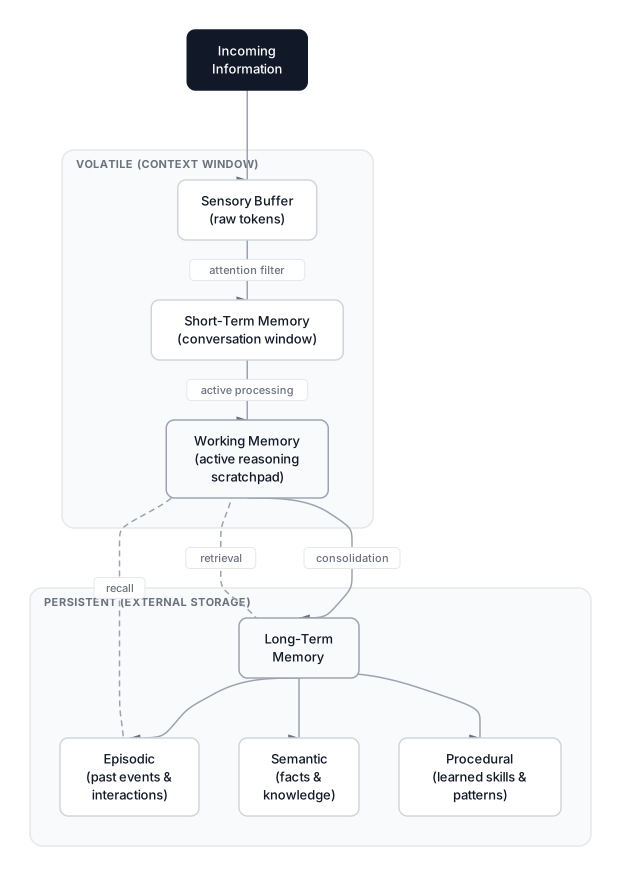 Click to expandAI agent memory types taxonomy
Short-term memory holds the current conversation context: the student's last few messages, the current problem, and the tutor's recent responses.
Working memory is the active reasoning scratchpad. While short-term memory stores what was said, working memory tracks what the agent is thinking right now: intermediate calculations, hypothesis tracking, multi-step plan states. When our tutor walks a student through a proof, working memory holds the current step and what comes next.
Long-term memory persists across sessions and splits into three subtypes that directly mirror human cognition:
| Memory Type | Human Parallel | AI Tutor Example |
|---|---|---|
| Episodic | "I remember that event" | "Last Tuesday, this student solved integration by parts after two failed attempts" |
| Semantic | "I know this fact" | "This student is strong in algebra but weak in trigonometry" |
| Procedural | "I know how to do this" | "Use Socratic questioning when this student is stuck, not direct answers" |
Key Insight: A December 2025 Tsinghua University survey taxonomizes agent memory by function into three categories: factual memory, experiential memory, and working memory. Production agents implementing multiple memory types show measurably better task completion on multi-session benchmarks.
Short-Term Memory: The Conversation Window
Short-term memory is the simplest layer and the one every chatbot already has: the conversation history stuffed into the context window on each LLM call. Simple in concept, tricky in practice.
Even with models offering 200K or 1M token windows in early 2026, you can't dump an entire user's history into every prompt. For our tutor with thousands of students, brute-force inclusion is both expensive and slow. Three strategies manage this:
Sliding window. Keep the last N messages. Fast and cheap, but the tutor loses context from earlier in the session. If a student referenced a formula twenty messages ago, it vanishes.
Summarization. Periodically condense older parts of the conversation into a summary, then prepend it. The tutor retains the gist of the entire session without the token cost. The tradeoff: summaries lose nuance.
Sliding window with summary prefix. The production-grade approach. Keep the last N messages verbatim, summarize everything older. The tutor gets both: precise recall of recent exchanges and compressed context from earlier.
# Sliding window with summary — conversation buffer for the AI tutor
class ConversationBuffer:
    def __init__(self, max_turns=10):
        self.messages = []
        self.summary = ""
        self.max_turns = max_turns

    def add_message(self, role, content):
        self.messages.append({"role": role, "content": content})
        if len(self.messages) > self.max_turns:
            # In production, call an LLM to summarize the oldest messages
            overflow = self.messages[:-self.max_turns]
            self.summary += self._summarize(overflow)
            self.messages = self.messages[-self.max_turns:]

    def get_context(self):
        """Returns the full context to inject into the LLM prompt."""
        context = []
        if self.summary:
            context.append({"role": "system", "content": f"Previous context: {self.summary}"})
        context.extend(self.messages)
        return context

    def _summarize(self, messages):
        # Placeholder — real implementation calls an LLM
        texts = [f"{m['role']}: {m['content']}" for m in messages]
        return f" [Summary of {len(messages)} messages: {'; '.join(texts[:2])}...] "
For our tutor, this buffer preserves the current lesson's flow. When the student says "wait, go back to that formula," the tutor can look at recent messages. But when the session ends, this buffer gets flushed. That's where long-term memory takes over.
Working Memory: The Reasoning Scratchpad
Working memory is the most overlooked layer in agent design, and the one that matters most for complex tasks. It isn't conversation history. It's the agent's internal state during multi-step reasoning.
When our AI tutor helps a student solve a calculus problem, it needs to track which step they're on, what approach they chose, where they went wrong, and what hint to give next. In practice, working memory is a structured object within a single task execution:
# Working memory for the AI tutor during a problem-solving session
tutor_scratchpad = {
    "current_problem": "Find the derivative of f(x) = x^3 * sin(x)",
    "student_approach": "Attempting product rule",
    "step_reached": 2,
    "errors_detected": ["Forgot to apply chain rule to sin(x) term"],
    "hint_level": 1,  # 1=subtle, 2=direct, 3=show solution
    "time_on_problem_seconds": 145
}
This scratchpad updates with every turn. If the student corrects their mistake, errors_detected gets cleared. If they stay stuck, hint_level increments. The LLM reads this state on each call and decides what to do next.
Pro Tip: Keep working memory structured, not free-text. A JSON scratchpad that the LLM reads and writes is far more reliable than asking the model to "remember" state across reasoning steps. Structured state survives prompt engineering changes; free-text state drifts.
Long-Term Memory Architecture
Long-term memory is where agent memory gets architecturally interesting. The goal: store information that persists across sessions, scales to millions of memories, and retrieves relevant context in milliseconds.
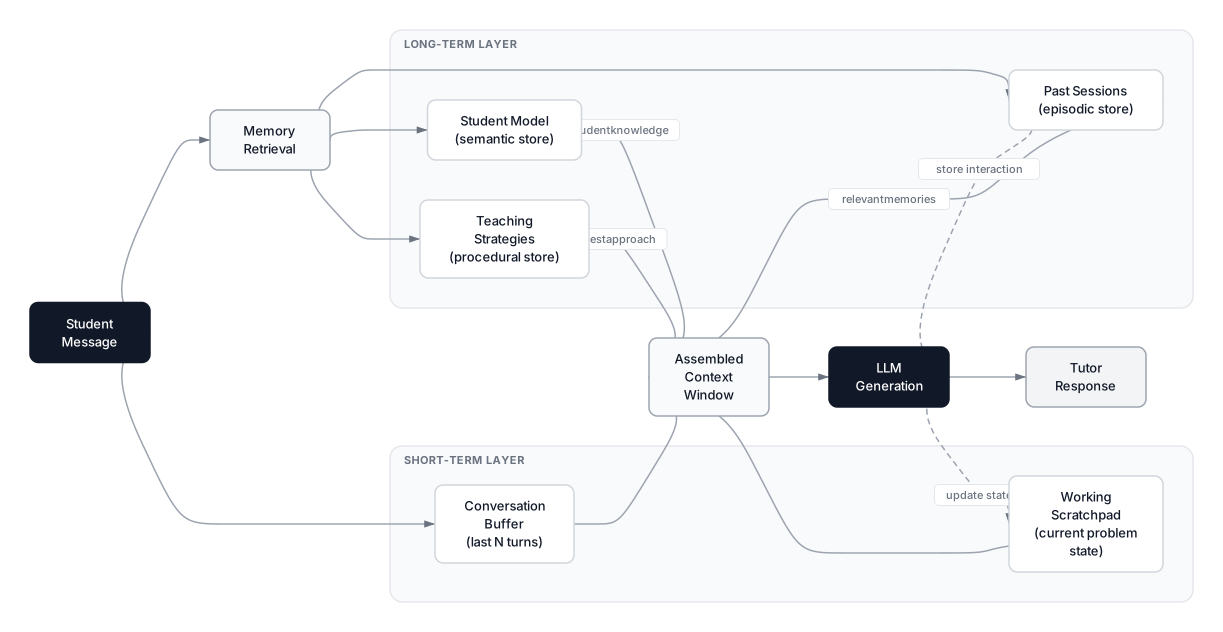 Click to expandAI tutor memory architecture showing all layers working together
The Storage Layer
Most production systems use text embeddings as their foundation. Each memory gets converted into a dense vector, stored in a vector database for fast similarity search. The vector database choice matters. As of March 2026, purpose-built databases handle billions of vectors using HNSW indexing, where complexity grows logarithmically:
| Database | Architecture | Scaling Profile | Best For |
|---|---|---|---|
| Pinecone | Serverless managed, ~70% share in the managed segment | Sub-50ms at billion scale | Teams wanting zero ops overhead |
| Qdrant | Rust-native, self-hosted or cloud | Low-latency p95 (benchmarks vary by workload), highest open-source throughput | High-throughput, low-latency retrieval |
| Weaviate | Hybrid search (vector + keyword) | Competitive p95 (benchmarks vary by workload), strong hybrid queries | RAG agents needing combined search modes |
| pgvector | PostgreSQL extension | Practical ceiling around 50-100M vectors | Teams already on PostgreSQL, moderate scale |
Pro Tip: Start with vector search and add complexity only when retrieval quality becomes a bottleneck. Many teams jump to graph databases prematurely. A well-tuned HNSW index handles most memory workloads.
Vectors alone aren't enough, though. Graph-based memory has emerged as a powerful complement. Mem0 introduced graph memory in January 2026, storing memories as directed labeled graphs where entities are nodes and relationships are edges. For our tutor, this means representing not just "student knows algebra" as an isolated fact, but encoding the relationship: "algebra_skills -> prerequisite_for -> calculus_readiness." Graph structure enables reasoning that pure vector similarity can't.
The Consolidation Process
Raw conversation transcripts make terrible memories. They're verbose, redundant, and full of noise. Consolidation extracts salient facts and stores them efficiently:
- Extraction. After each session, an LLM reads the transcript and pulls out key facts: "Student solved 4/5 derivative problems. Struggled with product rule. Preferred visual explanations."
- Deduplication. The system checks if similar memories already exist. If "student struggles with product rule" was stored last week, we update rather than duplicate.
- Conflict resolution. If the student has now mastered product rule, the old memory needs updating. The most recent observation overrides older contradictory ones.
Mem0 handles this pipeline automatically, achieving 26% better accuracy than OpenAI's built-in memory on the LOCOMO benchmark, with 91% faster responses and up to 90% prompt token reduction.
Implementation: Building a Memory Store
Let's build a working memory retrieval system for our AI tutor. This implementation uses multi-signal scoring: combining semantic similarity, temporal recency, and importance weighting.
Expected output:
Query: 'Student wants to review calculus topics'
=======================================================

  #1 (score: 0.8827, age: 1 steps)
     Requested extra practice on integration

  #2 (score: 0.8274, age: 2 steps)
     Solved chain rule problems independently

  #3 (score: 0.7967, age: 5 steps)
     Asked about derivatives for the first time


Effect of recency weighting:
-------------------------------------------------------

Pure semantic search (relevance only):
  score=0.8684, age=1: Requested extra practice on integration
  score=0.7283, age=5: Asked about derivatives for the first time
  score=0.7208, age=2: Solved chain rule problems independently

Recency-biased search:
  score=0.908, age=1: Requested extra practice on integration
  score=0.8813, age=2: Solved chain rule problems independently
  score=0.8461, age=5: Asked about derivatives for the first time
Notice how scoring weights reshape results. Pure semantic search ranks the oldest calculus memory second (high cosine similarity), but recency-biased search pushes it to third, favoring recent chain rule and integration memories. For our tutor, recency bias makes sense: recent progress matters more than what happened five sessions ago.
Memory Retrieval Strategies
The code above demonstrates the core retrieval formula. Let's formalize it:
Where:
- is the final retrieval score for memory
- is the cosine similarity between the query embedding and memory embedding
- is the temporal decay rate (typically 0.99 to 0.999)
- is the time elapsed since memory was created
- is the importance score assigned to memory
- are weights that sum to 1.0
In Plain English: Each memory gets three sub-scores: relevance to the current question (cosine similarity), recency (exponential decay), and how important it was marked when stored. For our tutor, a high-importance memory like "student had a breakthrough on derivatives" stays retrievable even weeks later, while routine memories like "completed homework set 7" fade unless directly queried.
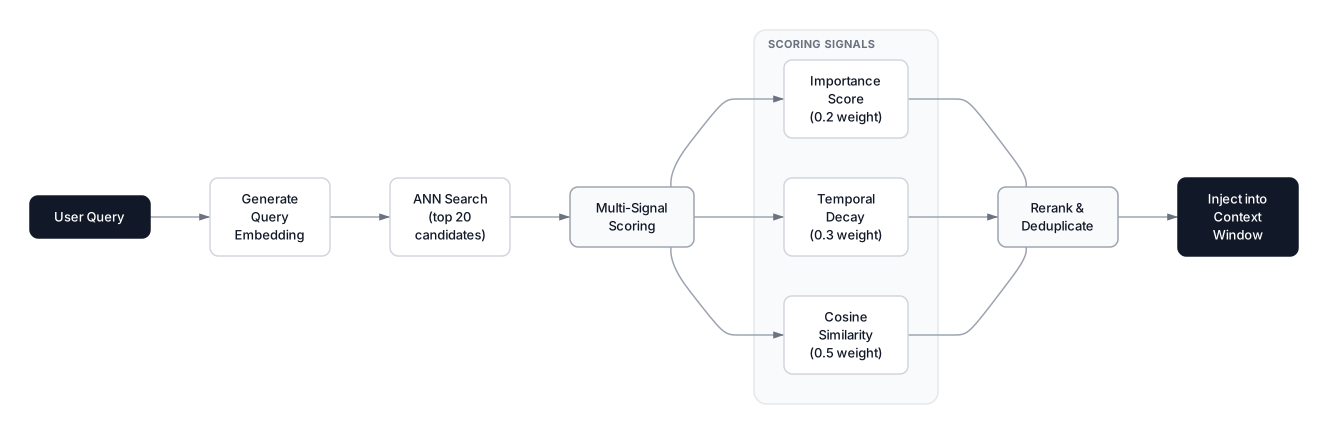 Click to expandMemory retrieval pipeline showing multi-signal scoring
The Generative Agents paper (Park et al., 2023) originally proposed this three-signal approach. Zep's temporal knowledge graph extends it by traversing relationship edges, enabling queries like "what concepts did this student learn before attempting calculus?" that pure vector search can't answer.
The Memory Framework Ecosystem
Building memory from scratch is educational, but production systems should consider existing frameworks. As of March 2026, the dedicated memory layer market has attracted over $55M in venture funding.
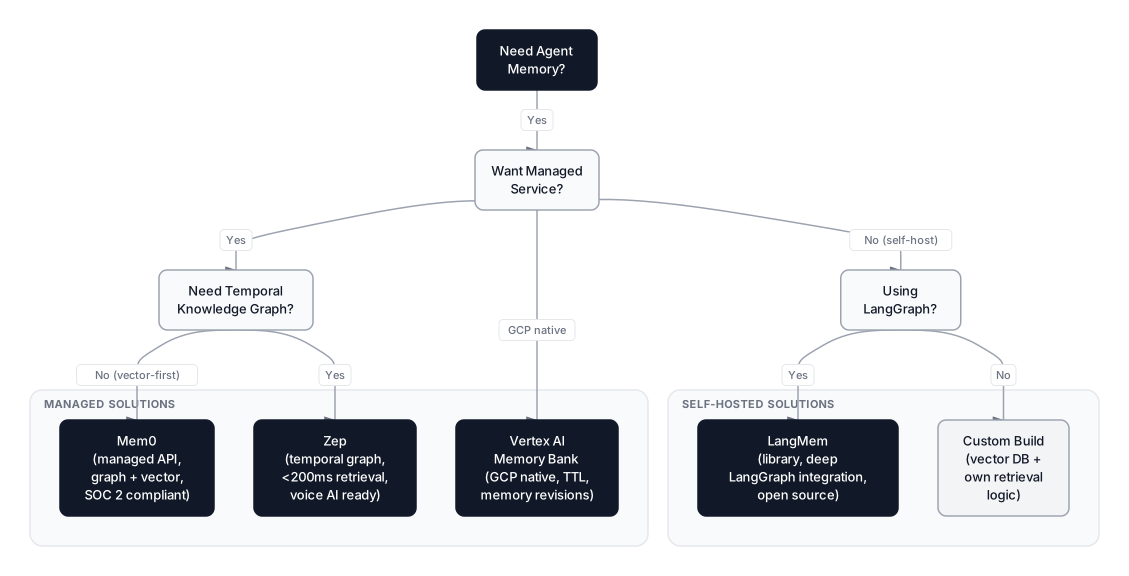 Click to expandMemory framework selection decision tree
| Framework | Type | Best For | Key Differentiator |
|---|---|---|---|
| Mem0 (v1.0.5) | Managed API + open-source SDK | Production apps needing managed infrastructure | Triple-backend storage (vector + KV + graph), 48K GitHub stars |
| Letta (MemGPT) | Open-source framework + cloud | Stateful agents with OS-inspired memory | Self-editing memory with core/archival hierarchy, $10M funding |
| Zep | Managed platform (Graphiti engine) | Temporal reasoning over evolving facts | Bi-temporal knowledge graph with fact supersession |
| LangMem (v0.0.30) | Open-source library | LangGraph-native agents | Deep LangGraph integration, self-modifying procedural memory |
| Vertex AI Memory Bank | GCP managed service | Google Cloud teams | Auto-TTL expiration, memory revisions, metered billing |
| Claude Memory | Model-native (Anthropic) | Claude-based applications | Persistent memory across conversations (consumer), file-based project memory (Claude Code) |
Mem0
Mem0 is the most popular dedicated memory layer, backed by $24M in total funding ($3.9M seed + $20M Series A, October 2025) with over 48,000 GitHub stars:
from mem0 import Memory

m = Memory()

# Store a memory
m.add("Student mastered quadratic equations after 3 sessions", user_id="student_42")

# Retrieve relevant memories
results = m.search("How is the student doing with algebra?", user_id="student_42")
Mem0 stores each memory across three backends: a vector store for semantic search, a key-value store for fast lookups, and a graph database for relational queries. It offers hierarchical memory at user, session, and agent levels. The platform is SOC 2 Type I certified and HIPAA-ready, which matters if your tutor handles student data under FERPA.
Letta (MemGPT)
Letta grew out of the MemGPT research paper, which introduced an OS-inspired memory hierarchy for LLM agents. Instead of treating memory as a flat vector store, Letta agents manage their own memory through tool calls: writing to core memory (always in context), searching archival memory (long-term storage), and recalling conversation memory (past interactions). Backed by $10M in funding, Letta offers both an open-source framework and a hosted cloud platform for deploying stateful agents.
Zep
Zep builds a temporal knowledge graph where facts have timestamps and can be superseded. When our tutor stores "student struggles with product rule" in January and "student mastered product rule" in March, Zep explicitly marks the first fact as outdated. Its Graphiti engine uses bi-temporal modeling: tracking both when events occurred and when they were ingested.
LangMem
LangMem is a library (not a service) built by the LangChain team for deep LangGraph integration. It distinguishes between semantic memory (facts), episodic memory (few-shot examples from interactions), and procedural memory (learned behaviors that update the agent's system prompt over time). That last type is particularly interesting for tutoring: the agent rewrites its own instructions based on what teaching strategies have worked.
Google Vertex AI Memory Bank and Claude Memory
Vertex AI Memory Bank provides managed memory with automatic TTL-based expiration and versioned memory revisions. Anthropic took a different approach with Claude's memory, which exists at multiple layers. Consumer Claude (claude.ai) has persistent memory across conversations, learning user preferences over time. Claude Code uses project-level Markdown memory files for codebase context. The Claude API itself remains stateless; developers building on it must implement their own memory layer. In March 2026, Anthropic made consumer memory free for all users and introduced a memory import tool for transferring histories from other providers.
Production Challenges
Building memory is one thing. Operating it at scale is another.
Memory pollution. Agents store too much, and retrieval quality degrades. Store insights, not transcripts. "Student needs more practice with integration by substitution" is useful. "Student said 'hmm I'm not sure about this integral'" is noise. Mitigate with importance scoring at write time and TTL-based expiration.
Stale memories. Students improve. Without temporal awareness, the tutor might still treat a student as a calculus beginner months after they've mastered it. Zep's temporal graph handles this explicitly; with simpler systems, you need scheduled reconciliation.
Privacy and the right to forget. GDPR, CCPA, and FERPA require the ability to delete all memories for a user. Namespace isolation via user_id isn't optional; it's a legal requirement.
Cost at scale. Vector storage is cheap. Embedding generation isn't. A tutor serving 100,000 students with 50 memories each means 5 million vectors, under $50/month in storage. The real cost is LLM calls for extraction and consolidation, which can dwarf storage by 10x to 100x. Batch consolidation at session boundaries rather than per-message.
Common Pitfall: Teams optimize for retrieval latency while ignoring write-path costs. If your agent calls an LLM to consolidate memories after every turn, you may spend more on memory management than on actual responses.
When to Use Each Memory Type
Not every agent needs every memory layer. Over-engineering is as common as under-engineering.
| Scenario | Memory Layers Needed | Why |
|---|---|---|
| Single-turn Q&A bot | None (stateless) | No continuity needed |
| Multi-turn chat assistant | Short-term only | Session context sufficient |
| Customer support agent | Short-term + semantic long-term | Needs user history across tickets |
| AI tutor | All four types | Requires full student modeling |
| Coding agent | Short-term + working memory | Needs reasoning state, not long history |
| Personal assistant | Short-term + episodic + semantic | Needs to remember events and preferences |
When NOT to Use Long-Term Memory
Long-term memory adds complexity, cost, and privacy liability. Skip it when your agent handles independent, self-contained queries (search, translation), when users explicitly don't want personalization, when regulatory constraints make data retention risky, or when the task is short-lived by nature (one-off code review, document summarization).
When Long-Term Memory Is Essential
Invest in it when user satisfaction depends on continuity ("I already told you this last week"), when the agent must adapt behavior over time, when business value compounds with history, or when you're building agentic RAG systems where retrieval improves with user feedback.
Conclusion
Agent memory separates chatbots from assistants, demos from products. The architecture mirrors human cognition: short-term memory for the current conversation, working memory for active reasoning, and long-term memory split into episodic, semantic, and procedural stores.
Frameworks like Mem0, Letta, Zep, and LangMem handle the hard parts of extraction, consolidation, and retrieval. For our AI tutor, this means a system that genuinely knows each student: their strengths, weaknesses, preferred learning style, and trajectory over time.
Start simple. A conversation buffer and basic vector store cover most use cases. Add working memory when your agent does multi-step reasoning. Add graph-based long-term memory when relationships between memories matter. And always build in the ability to forget. For the broader agent architecture, see our guides on function calling and tool use, how RAG works, and context engineering for LLMs.
Frequently Asked Interview Questions
Q: What is the difference between short-term and working memory in an AI agent?
Short-term memory stores conversation history (what was said). Working memory stores the agent's internal reasoning state (what it's currently thinking). Short-term memory is a transcript; working memory is a structured scratchpad tracking intermediate results and plan progress during multi-step tasks.
Q: How would you design a memory system for an agent serving millions of users?
Namespace all memories by user_id for isolation and GDPR compliance. Use a managed vector database with HNSW indexing, which scales logarithmically. Batch LLM calls for extraction and consolidation at session boundaries rather than per-message, and set TTL-based expiration to prevent unbounded growth.
Q: Why do some agent memory systems use knowledge graphs instead of just vector databases?
Vector databases excel at semantic similarity but can't answer relational or temporal queries. A knowledge graph can represent "concept A is a prerequisite for concept B" or "fact X supersedes fact Y as of date Z." The recommended pattern: start with vector search, then selectively introduce graphs for high-value entity relationships.
Q: How do you handle contradictory memories in a long-running agent?
Three approaches, in order of sophistication: timestamp-based resolution where the most recent memory wins, explicit supersession where new memories mark old ones as outdated (Zep does this natively), and LLM-based reconciliation where a model periodically resolves conflicts. Option 2 offers the best balance of reliability and cost.
Q: What is temporal decay in memory retrieval, and how do you tune the decay rate?
Temporal decay applies an exponential penalty to older memories: , where is typically between 0.99 and 0.999. Tune based on domain: customer support agents need slower decay (conversations reference issues from months ago), while coding agents need faster decay (recent context matters most).
Q: Compare Mem0, Zep, and LangMem for a production deployment.
Mem0 offers a managed API with triple-backend storage and SOC 2 Type I/HIPAA-ready compliance posture, ideal for teams that want infrastructure handled. Zep focuses on temporal knowledge graphs, best when facts change over time. LangMem is free and open-source, tightly integrated with LangGraph, best for teams who want to own their infrastructure.
Q: How does memory pollution affect agent quality, and how do you prevent it?
Memory pollution occurs when agents store too many low-value memories, degrading retrieval precision. Prevention strategies include storing insights rather than raw transcripts, using importance scoring at write time, applying TTL-based expiration, and running periodic consolidation to merge redundant memories.
Q: When should you build custom memory versus using an existing framework?
Use a framework when you need compliance features, managed infrastructure, and proven retrieval quality at scale. Build custom when you have domain-specific consolidation logic or custom scoring signals beyond the standard relevance-recency-importance triad. Most teams should start with a framework.